Home and Garden Guidebook

Thursday, 12 September 2024

New Science and Engineering Blog!

A series of miscellaneous articles, both curated and original covering various STEM topics.

The blog's editor Eugene Brennan is a qualified engineer with a BSc(Eng) degree in electrical, electronic, control and instrumentation engineering from Dublin Institute of Technology and FETAC certified in industrial automation (mechatronics and pneumatics). He has worked on the development of SCADA systems and data loggers, designing instrumentation electronics and developing telemetry software. He's also passionate about gardening and DIY. 

You can view the blog here.

Thursday, 21 September 2023

How to Get Your Home Ready for Winter


There are lots of ways to prepare your home for winter's freezing temperatures. © Eugene Brennan


Winter Is Coming!

This article gives you some common sense tips on keeping your home snug and warm in the winter. It also provides information on how to protect your home and yard from cold, wind, rain, and snow. 

What Is Insulation? 

Insulation is any material that reduces the rate of heat transfer. For instance, the handle on a saucepan is insulated so you don't burn your hand. Metal is good at transferring or conducting heat, so saucepan handles are usually made from wood or plastic to stop heat conduction.

In the context of a building structure, however, insulation is a material that is used to stop heat flowing out through the walls, ceiling and floor. Usually, this is in the form of boards with an insulating foam layer or layers of fleecy material such as fibre glass, rock wool or sheep's wool. If rooms are well insulated, once they're heated, they hold the heat for longer and it doesn't leak out so fast.

How to Keep the House Warm in Winter

There are numerous ways to keep the chill at bay when temperatures drop.

General Tips

  • Single-glazed windows should be upgraded to double or triple-glazed units.
  • Boilers should be serviced to ensure they are working correctly, the flue is clean, fuel is being burnt thoroughly and they are working at top efficiency. Circulating pumps can become stuck during the summer so this needs to be checked out.
  • Chimneys of open fires need to be cleaned to remove soot and creosote deposits or leaves from overhanging trees. Guards should be fitted to the chimney pots to prevent birds setting up residence the following spring.

Insulation Upgrades

  • If you can afford it, try to upgrade the insulation in the house. Most heat is lost up through the ceilings into the loft and out through the roof. The space between the joists should be insulated with 4 inches (preferably 8 inches) of fibreglass or rock wool insulation.
  • Inner walls can be insulated with rock wool and finished with plasterboard (drywall), or plasterboard backed with foam insulation may be used.
  • Cavity walls can be drilled and a foam insulation pumped into the intervening space.
  • External insulation is also an option. Multilayer sandwich panels consisting of insulation, a water-permeable membrane and an outer painted finish can be retrofitted to exterior walls. Some contractors render the finished insulation when it is installed.

Exterior House Maintenance

  • Gutters and downpipes need to be cleaned to ensure proper drainage from roofs, but wait until the leaves have fallen off all nearby trees or you will have to do the job again later!
  • Remove any moss or leaves which accumulated in the valleys between apex roofs.
  • Ensure all brackets, nails and screws holding the gutters are secure.
  • Check your downpipes are not clogged.
  • Drips from overflowing gutters in the winter can form large icicles.
  • Check gulleys for blockages from leaves and other debris.
Gate Valve. © Eugene Brennan     


Protecting Plumbing From Freezing

  • Frozen and burst pipes are a common problem during freezing weather. All pipes which may be exposed to freezing temperatures should be lagged with insulation to prevent freezing. New pipe work should be buried deep enough in the ground to protect it from freezing.
  • The cold water tank in the loft should be surrounded with a layer of insulation and the associated pipe work should be lagged. When the floor of the loft is insulated, this makes the loft colder and plumbing is more prone to freezing, so during extremely cold or snowy weather, the loft door should be left open to allow some heat from the rooms below to travel upwards.
  • Ensure you know the location of all your gate valves/stop cocks inside and outside and their functions. Write their function on the wall behind them with a thick marker and obviously check they actually turn and aren’t seized. You don’t want to be trying to turn off a seized valve in an emergency when water is coming down through the ceiling!
  • You can use pipe heating cable to stop pipes from freezing where pipes are exposed to really cold temperatures. This comes in the form of a tape or cable that you wrap around the pipe. The tape warms slightly when powered up. Newer versions of this tape are self-regulating so temperature doesn't become excessive.

Preparing for Ice and Snow

  • Ensure you have adequate supplies of fuel. Oil, gas and electricity suppliers are competitive so shop around to get the best deal.
  • Get a good quality snowblower, snow or grain shovel for clearing snow from pavements and driveways. A blade made from aluminium is lighter than a steel blade.
  • Clean moss from pavements with a proprietary cleaner or power washer.
  • Stock up with salt and grit for defrosting snow and ice on pavements.
  • Gutters should have adequate brackets to support snow load as snow starts to thaw and slide down roofs.
  • Drain hoses to prevent them freezing and bursting.
  • During thunderstorms which can occur during blizzards, unplug all electrical appliances and landline equipment such as modems and phones and use your cell phone for communication.
  • Stock up with torches and a camp stove in case there are power failures.
  • Get some storage containers which can be used to hold water in case the water supply pipes freeze and the supply is interrupted.

Protecting Garden Plants From Frost

If possible, bring vulnerable plants in containers which could be damaged by frost, inside or into a frost-free shed. Wrap bubble wrap or straw around larger plants or plants in the ground.

Here are a few more ways to protect your plants from frost.

Coping With Electrical Power Outages

  • If you have a generator, make sure it works properly, the oil level is ok and it starts up without difficulty. Test it under load to see if copes ok without struggling.
  • A freezer will maintain low temperature for several hours if it is not constantly opened.
  • A portable gas stove can be used for heating and cooking.
  • The backup batteries in your alarm panel and bell/sounder have a limited lifespan so replace them at the required interval.


Thursday, 4 June 2020

Why Doesn't My Power Tool Startup?

When a power tool won't power up there are various causes of failure. but troubleshooting should be done in a methodical order, the main thing though is to check the obvious first!

Equipment Needed:


Some screwdrivers, flat and Phillips head
Continuity meter or multimeter to trace continuity from the plug to the motor.


A non-contact voltage detector (optional). These devices glow when the tip is held close to a live cable


https://dengarden.com/home-improvement/Using-a-Multimeter

Important !!!
Remember to avoid shock, disconnect the tool from the mains supply before troubleshooting!!!


Troubleshooting: 


 ● It may be obvious but ensure the socket outlet isn't faulty, try the tool in another outlet to see if it works.

● Check whether the overload circuit breaker if fitted on the tool has activated. This happens e.g. on a table saw when the motor is stalled. To reset you need to press a button. The breaker may need a couple of minutes to cool down before resetting

● If plug is rewireable check for loose screws at plug pin terminals, loose fuses etc. 


● A common cause of failure especially with drills and other hand held tools is one or more broken wires in the power flex caused by metal fatigue in the cable (like when you break a paper clip by bending it backwards and forwards) , this usually happens where the cord leaves the plug or where the cord enters the tool. If you have a non-contact voltage detector, you can use it to trace the break from the plug to the tool. Plug in the tool and hold the tip of the detector at the plug, it will glow here but as it is moved down along the flex it will stop glowing after the break (If the break is in the live core of the cable)

● Sometimes it is possible to detect where a break is in a flex by stretching it, the flex will narrow in the region of the break

● If you still can't trace the fault, unplug the tool. Open it. Check the continuity from each pin of the plug to the switch in the tool.

● A faulty on / off switch can prevent the tool from working. Use the continuity tester to check this

● Loose spade terminals on switches may cause intermittent operation

● Tools with green and red start and stop buttons may have a faulty relay

● The brushes in the motor may have worn down

● The armature or field coils of motor may have gone open circuit. The field coils can be checked with the continuity meter

Tuesday, 19 May 2020

String Trimmer Line

This 0.095 inch diameter (2.4mm), 3 pound, 685 foot spool of professional trimming line manufactured by Oregon should last you years and years. It has a high strength inner core and an outer coating to prevent welding. In other words it is less likely to stick as it unwinds from the spool. The square edges also improve cutting efficiency compared to standard round profile type
Check your trimmer to see whether it is compatible with this diameter line.

Sunday, 19 April 2020

Activities for Kids During the Covid-19 Lockdown: Sowing Seeds

Equipment

  • Some trays, pots, yogurt containers or similar
  • Spray bottle from shower or window cleaner
  • Seed compost or multipurpose seed and potting compost
  • Seeds

Time to sow

For annual and half-hardy annuals, February to April. Check the seed packet.

You can use any types of pots, boxes or proper seed trays

Steps

  1. Fill the containers almost to the top with seed compost
  2. Shake the seeds out onto your hand and scatter evenly over the compost
  3. Don't cover very small seeds. Seeds a few mm in diameter can be covered with a sprinkling of compost. Larger seeds such as sunflower seeds should be pushed about 1/2 inches (12mm) below the surface.
  4. Water with the spray bottle and keep the compost moist. Only water as needed, not everyday. You can use a watering can, but unless it has a fine sprinkler rose, it can flood the compost and wash away seedlings.
  5. Keep the tray in a warm place and cover with a sheet of card to conserve moisture and keep the seeds dark until germination
  6. Once the seeds germinate, remove the card and move to a bright place such as a window sill.
  7. Transplant into pots once seedlings have their first pair of "true leaves" (the second pair of leaves to appear). Once the plants become large enough, transfer to their final location.

Fill tray with compost

Sprinkle seeds from your hand
Transplant seedlings once they're big enough and have two "true" leaves

Wednesday, 22 January 2020

Repairing a Heat Selection Knob on a Fan Heater

Well this was frustrating! The range selection knob on my fan heater was turning without doing anything. I decided to try and open the case to see what was wrong, but of course the manufacturer had used security fixings, relatively uncommon triangular ones too!


I have lots of shapes and sizes of Torx bits and screwdrivers, but they would be useless in this situation. Luckily I managed to undo two of four screws from the upper side of the heater using a large jeweler's screwdriver. This allowed me to pull the case apart just enough to remove the knob.


Part of the shaft of the knob had snapped off in the switch. Gluing, even with superglue wouldn't be a permanent fix because the resistance of the switch was such that a large torque was needed to change range.
First I removed the broken-off piece of shaft from the switch using a woodscrew. The piece was hollow as was the other piece of shaft remaining on the knob. I decided to attach the two pieces together using a rivet pin.


I hoard lots of scrap, and rivet pins are part of my collection, along with self tapping screws, springs, nuts, washers and all sorts of other miscellaneous items! Some of these pins were exactly the right diameter.

I dripped some super glue into the hollow interior of both sections and also on the broken surface, then joined the two pieces together. Some heat from another fan heater accelerated curing of the glue.


After trimming the pin, I replaced the switch, cost of repair? Zero!

Monday, 20 May 2019

How Do I Mix Fuel for My String Trimmer, Hedge Trimmer or Chainsaw?

These garden power tools generally have a two stroke engine (also known as a two cycle or 2T engine), and to make them lighter, they don't carry motor oil on board as in the case of a lawn mower or road vehicle. Instead oil is added and mixed with the petrol (gas) before use.
In general petrol/oil ratio for 2-stroke engines is 40:1 or 50:1 which is 2.5% or 2% oil. 50:1 is equivalent to 20ml in 1 litre or just over 2 1/2 US fluid ounces per US gallon. 40:1 is equivalent to 25ml in 1 litre or 3.2 US fluid ounces per US gallon. 

After adding oil, swirl the contents around to ensure it's thoroughly mixed.Consult the manual of the machine for details of the recommended ratio.


Tuesday, 12 March 2019

Homemade Tools - Snow Rake

I put this together from scrap 2 x 1 and 3/8" (10mm) plywood. I used some pieces of waste wire from electric cable (string would be just as good) as ties to stop the board pulling off the end of the 2 x 1.


Tuesday, 5 March 2019

New Science Q&A Article for Children

Just published a new science guide for children.

"Top 100 Interesting Science Questions for Kids" covers space, nature, technology, engineering, elementary math, chemistry, physics and biology.


Sunday, 24 February 2019

AA to C and D Battery Converters

These are useful little gadgets if you don't have any C or D cells to hand. AA cells are readily available in cheap packs from pound/dollar/euro shops and are probably also optimised to have a higher energy density.


Tuesday, 19 February 2019

Snow Shovels by Briggs & Stratton

Think I'd prefer shovelling by hand to warm up, but these snow shovels by Briggs & Stratton could be useful!


Lidl Tools from the Centre Aisle - Air Wedges

Picked up this set of air wedges in Lidl . They're like a mini version of what firemen use. Handy for lifting and positioning stuff and pushing things apart.


Valves for Shutting Off Water in the Home

Just a reminder folks to identify where all your gate valves are for shutting off water in an emergency. Tie a label around them or write the function on the wall behind with a thick marker. Valves can and do seize, so it's good to exercise them at least once a year. You don't want to be running around like a headless chicken when there's a water leak.

Monday, 18 February 2019

Cutting Down the Overgrown Sycamore


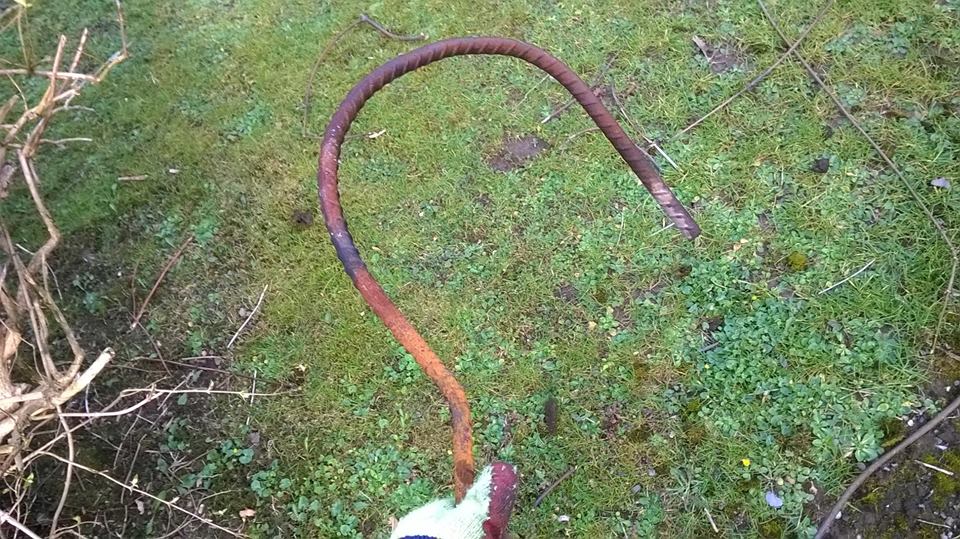
My shepherd's hook for pulling down the overgrown sycamore in the back garden. The plan was to cut low and reach high with the 20 foot hook to get leverage, without having to climb up to tie ropes.


The hook was made from a 6m length of 12mm rebar, with a loop at one end for hooking around limbs and a smaller loop at the other end for attaching a rope. Unlike a rope, the hook was rigid and could be extended high up into the crown, without having to do any climbing.


One 8" bough down, about 8 more to go. This one managed to land on a sheet of steel that sliced into it.


I decided to make a rope saw for cutting through some of the limbs that were nearly vertical. It would have been dangerous to cut these with a chainsaw while I was up the tree. Using a rope saw was slow and hard work but really safe because limbs could be cut remotely and pulled down using a long rope and my sheperd's hook. The saw was made from an old chain saw chain. I cut one of the links with an angle grinder and opened it out, then attached the ropes to rings passed through link holes in the ends of the chain.


Finally finished cutting!


Lots of logs to cut up.


I chipped all the branches. They can be used as fuel on a stove or as a mulch in the garden for suppressing weeds.


By winter last year after a warm summer, the tree had put on 6 feet of new growth. Looks as if I'll have to do more lopping this year!


Sharp Vintage Calculators

My favourite calculator, the Sharp EL506. Really simple to use and no fancy "natural entry" nonsense that slows everything down in modern versions, with lots of extra keypresses required to do simple calculations. Cost me £5 in '84 when I started college. Batteries then lasted over 20 years.

Wednesday, 26 July 2017

"Talking Tools"

Just wanted to let you know about my new Facebook group "Talking Tools".
It's a platform for pros and newbies to talk about tools, share reviews and tips. Novices can ask questions and get help from more experienced members. Manufacturers can also show off their new products.

Talking Tools

https://www.facebook.com/groups/203863340138801/

Friday, 24 March 2017

Lawn Mower Won't Start? - Top 10 Small Engine Troubleshooting Tips

  1. Use fresh petrol (gasoline). Old petrol can cause difficult starting. Make sure there is enough fuel in the tank and check the vent in the tank cap isn'tclogged
  2.  The spark lead should be firmly attached to the plug, and the plug tightly screwed into the engine block. Try replacing the plug with a new one if the engine won't start
  3. Most modern mowers have a control handle which needs to be pushed forwards/upwards and held in place to keep the engine running. Make sure this control is mower is held fully against the mower handle while starting.
  4. If a manual choke is fitted, turn it on. Don't turn on the choke if the engine has been running in the last 10 minutes
  5. If the engine has a primer bulb, press it about 5 times. If the mower runs out of petrol during cutting, it will need to be primed again
  6. Check the air filter isn't dirty. Wash and dry foam type air filters in warm,soapy water. A paper filter can be blown out with an air compressor, but will eventually need to be replaced
  7. Check the cable connecting the "dead man's handle" (the control which keeps the engine running when held in place) to the engine is not damaged or snapped
  8. The carburettor should be tightly screwed or bolted to the engine
  9. Make sure there isn't any water collected at the bottom of the petrol tank. If there is, drain the tank and use a piece of stick or long screwdriver with a piece of rag tied on (with a twisty tie) to soak up water
  10. If the starter cord is hard to pull, check the underside of the deck and remove any clumps of grass which may be jamming the blade. Disconnect the spark lead before attempting to move the blade to remove clippings!
    Paper air filter

    Foam air filter

Wednesday, 7 December 2016

How Can the Pressure be Increased in a Shower?

If the shower is fed from a hot water tank, a cold water tank provides the pressure head to force out the hot water from the tank. This is usually in the loft to maximize the head so if it is located there, you are not going to be able to rise it any higher.
Cold water power showers are fed from the incoming mains cold water supply and the water is heated by a high powered electric element.
Shower heads incorporate a restrictor/aerator to reduce flow and water wastage. The Federal Energy Policy Act of 1992 made it a requirement that these were added to shower heads to reduce flow to about 2 gallons per minute, so removing this would increase the flow rate. Also it is possible to buy a shower head designed for a lower flow rate. This increases pressure but the flow rate will be less.
You can buy a booster pump which effectively works like a power washer and increases the pressure while keeping the flow rate constant.
×

Posts by Category